
What Are the Core Elements of a Brand Audit?
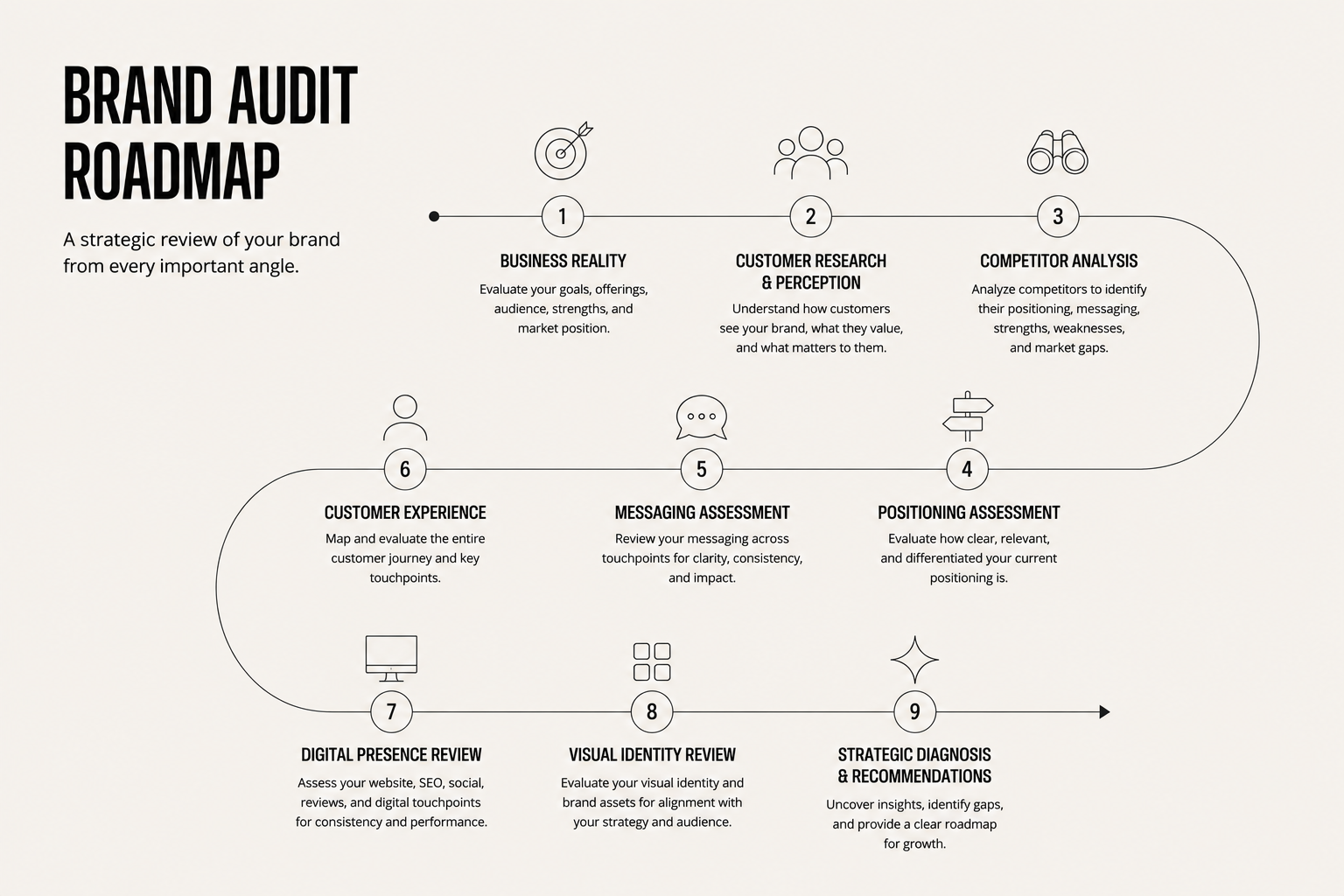
A brand audit is a strategic evaluation of how well your brand supports your business goals, connects with customers, and stands out from competitors.
Often, what business owners believe their brand represents doesn't match what customers actually see or experience. A professional brand audit helps uncover these gaps and identify opportunities to strengthen your brand.
Whether you're working with a brand strategist, a brand strategy consultant, or conducting your own review, a brand audit provides an objective assessment of what's working, what's holding your business back, and where the greatest opportunities for growth exist.
It looks beyond your logo, website, or social media profiles. A comprehensive brand audit evaluates your business strategy, customer perception, positioning, messaging, customer experience, and digital presence to understand how effectively your brand supports your business.
While every business is different, these are the nine core areas I evaluate during a strategic brand audit.
1. Business Reality
Before evaluating the brand itself, it's important to understand the business behind it.
A strong brand should support both your brand strategy and your business strategy—not work against either one.
This stage evaluates:
- Business goals
- Growth challenges
- Products or services
- Target audience
- Revenue drivers
- Competitive advantages
- Current marketing efforts
The goal is to determine whether your current brand supports the business you have today—and the business you want to become.
For example, a company planning to expand into premium services may still look and communicate like a budget provider. That disconnect makes growth much harder.
2. Customer Research & Brand Perception
Your brand doesn't exist inside your company—it exists in the minds of your customers.
Understanding how customers perceive your business is one of the most valuable parts of a brand audit because it often reveals opportunities that internal teams overlook.
This stage evaluates:
- Why customers choose your business
- What problems they're trying to solve
- What they value most
- Their concerns before purchasing
- How they describe your business
- The emotions your brand creates
- Your reputation among customers
Research may include:
- Customer interviews
- Surveys
- Online reviews
- Testimonials
- Social media comments
- Sales conversations
- Customer support feedback
Looking at these sources together creates a complete picture of how your brand is perceived. Patterns in customer feedback often reveal both your greatest strengths and the issues that may be limiting growth.
Sometimes the biggest gap is the difference between how a business wants to be perceived and how customers actually experience it.
3. Competitor Analysis
Customers rarely evaluate your business in isolation.
Before making a decision, they compare multiple options.
This stage evaluates:
- Competitor positioning
- Brand messaging
- Visual identity
- Customer reviews
- Brand promises
- Strengths and weaknesses
- Gaps in the market
The goal isn't to copy competitors.
It's to understand what space is already occupied, and where your brand has an opportunity to stand apart.
This research also helps identify opportunities that may later shape your brand strategy or rebrand strategy.
4. Positioning Assessment
A brand audit evaluates whether your current positioning clearly communicates why customers should choose your business over competitors.
Positioning is the foundation of every successful brand strategy, but before developing a new strategy, it's important to understand whether your current positioning is working.
This stage evaluates:
- Target audience
- Market category
- Current value proposition
- Point of difference
- Competitive advantages
- Reasons customers should believe your claims
- Alignment between positioning and customer perception
- Positioning compared to competitors
The key question is:
Does your current positioning clearly communicate what makes your business different—and does that difference matter to your ideal customers?
If the audit identifies gaps, refining your positioning may become one of the recommendations in your overall brand strategy.
5. Messaging Assessment
A brand audit evaluates whether your messaging clearly communicates your positioning across every customer touchpoint.
Even a great business can struggle if customers don't quickly understand what it offers or why it's different.
This stage reviews:
- Homepage copy
- Service pages
- Calls to action
- Sales materials
- Email marketing
- Social media
- Marketing campaigns
The key question is:
Can a potential customer understand what makes your business different within a few seconds?
If your messaging is unclear or inconsistent, customers often choose competitors simply because they understand them better.
6. Customer Experience
Every interaction shapes your brand.
Your marketing creates expectations.
Your customer experience either confirms or breaks those expectations.
This stage evaluates the entire customer journey—from the moment someone first discovers your business to becoming a loyal customer.
The review includes:
- First impressions
- Customer journey map
- Website experience
- Sales process
- Communication
- Onboarding
- Service delivery
- Follow-up
- Customer retention
A customer journey map helps identify every touchpoint where customers interact with your business. It highlights moments of friction, missed opportunities, and areas where the experience can be improved.
Many businesses have excellent marketing but lose customers because the experience doesn't match the promise.
A strong brand isn't defined by what you promise—it's defined by what customers consistently experience throughout their journey.
7. Digital Presence Review
Today, your website is often your first salesperson.
For many businesses, customers interact with your brand online long before speaking with anyone.
This stage evaluates:
- Website
- Google Business Profile
- Social media
- Online reviews
- Email marketing
- Local search visibility
- AI search visibility
- Brand consistency across platforms
The goal is to ensure every digital touchpoint communicates the same message and creates the same impression.
8. Visual Identity Review
Visual identity helps customers recognize and remember your business.
But good design isn't just about looking attractive.
It should support your positioning and appeal to the right audience.
This stage isn't about whether the design looks good—it's about whether it communicates the right message to the right people.
This review evaluates:
- Logo
- Color palette
- Typography
- Photography
- Graphic style
- Brand consistency
The key question is:
Does your visual identity reinforce your brand strategy?
While many businesses begin with a logo or a brand guide template, visual identity should always be built on strategy first.
A beautiful logo cannot fix unclear positioning, but strong visual identity can strengthen a well-defined brand.
9. Strategic Diagnosis & Recommendations
This is where all the research comes together.
Rather than looking at each area separately, a strategic brand audit identifies the relationships between them.
This stage answers questions such as:
- What's working well?
- What's creating friction?
- Where do customer perceptions differ from leadership's assumptions?
- What do competitors already own?
- What opportunities exist?
The final deliverable isn't simply a list of observations.
It's a roadmap for improvement.
Depending on the findings, recommendations may include:
- Refining brand positioning
- Clarifying messaging
- Improving the customer experience
- Strengthening your digital presence
- Refreshing your visual identity
- Developing a rebrand strategy
Every recommendation is based on research, customer insights, and evidence—not assumptions.
Why These Elements Matter
Many businesses assume they have a marketing problem when the real issue is much deeper.
Poor positioning, inconsistent messaging, confusing customer experiences, or a disconnect between how a business sees itself and how customers perceive it can all limit growth.
A comprehensive brand audit helps uncover those issues before investing more money in advertising, redesigns, or marketing campaigns.
That's why many businesses choose to work with a brand strategy consultant or freelance brand strategist. An outside perspective often uncovers blind spots that internal teams miss.
Instead of guessing what needs to change, you gain clear, evidence-based recommendations for strengthening your brand.
Whether you're a B2C company or building a B2B brand strategy, the goal is the same: create a brand that customers understand, trust, and choose over competitors.
Need Professional Brand Audit Services?
If you're unsure whether your brand is supporting your business goals, brand audit services can provide an objective assessment of your positioning, messaging, customer perception, and competitive landscape.
As a freelance brand strategist, I help businesses uncover opportunities for growth through strategic brand audits, customer research, competitor analysis, and brand strategy development. Every recommendation is based on research and evidence... not assumptions.