
What Is Brand Personality and Why Does It Matter?
Brand personality is the set of human traits people associate with a brand. A brand may feel warm, rebellious, playful, sophisticated, adventurous, dependable, or caring.
Think about how you describe people. You might say someone is confident, funny, serious, romantic, or down-to-earth. Customers describe businesses in similar ways—even when the company has never intentionally defined its personality.
That is why branding for a small business involves more than creating a logo. Your colors, words, customer service, packaging, website, social media, and even pricing all send personality signals.
A clear brand personality helps those signals work together. It makes the brand easier to recognize, remember, and connect with.
What are brand personality archetypes?
Brand archetypes are familiar character patterns that connect a brand with a deeper human motivation, fear, or desire.
The popular 12-archetype brand framework is rooted in Carl Jung’s broader ideas about recurring symbolic patterns. However, the familiar list of 12 was not created directly by Jung. Carol Pearson developed the 12-archetype system, and Margaret Mark and Carol Pearson later applied it to branding in The Hero and the Outlaw.
In branding, archetypes help connect what a product does with what the customer wants the experience to mean.
For example, a watch does more than tell time. Depending on the brand, it might represent:
- Achievement
- Adventure
- Social status
- Craftsmanship
- Self-expression
- Belonging to a community
The product is tangible. The meaning is not. An archetype helps connect the two.
What are the four main customer motivations behind brand archetypes?
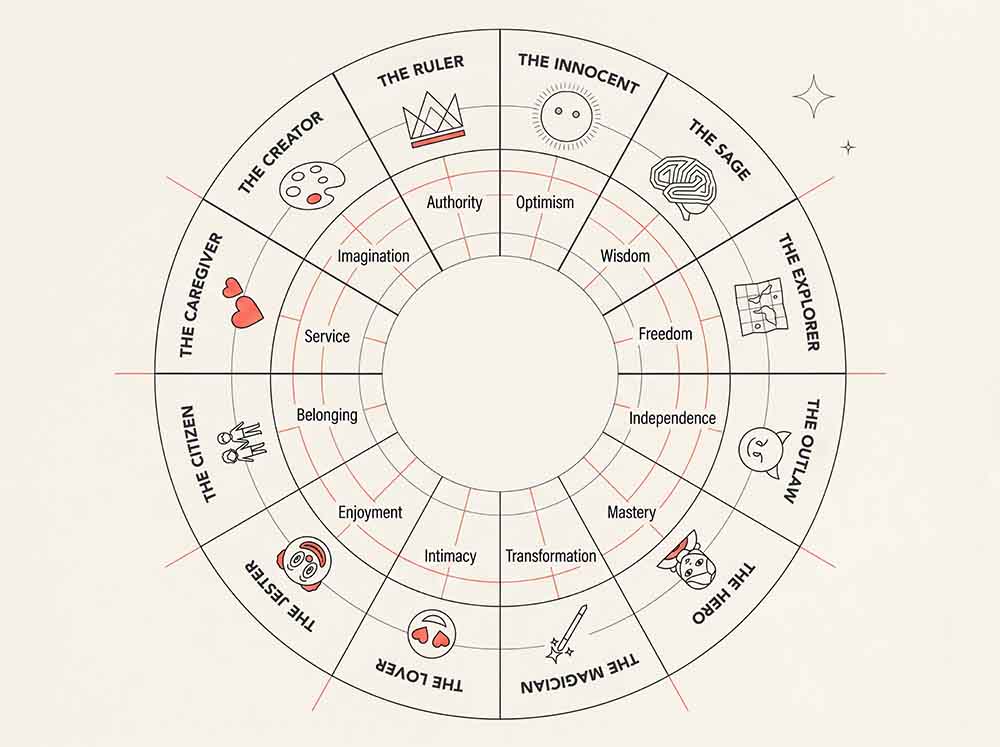
The 12 archetypes are often organized around four broad customer motivations: independence, mastery, belonging, and stability.
Understanding these motivations is important because they help explain why people choose one brand over another. Customers do not buy products only for practical reasons. They also buy products that help them feel free, capable, connected, or secure.
Independence and fulfillment
These customers want freedom, truth, discovery, or a more authentic life.
Related archetypes:
- Innocent
- Explorer
- Sage
Risk and mastery
These customers want to overcome limitations, create change, or make something transformative happen.
Related archetypes:
- Hero
- Outlaw
- Magician
Belonging and enjoyment
These customers want connection, pleasure, intimacy, or a sense of belonging.
Related archetypes:
- Regular Person
- Lover
- Jester
Stability and control
These customers want safety, order, care, structure, or the ability to shape their environment.
Related archetypes:
- Caregiver
- Creator
- Ruler
These motivations can prevent a business from relying too heavily on demographics.
A customer does not need to be an athlete to connect with the Hero. They may be building a business, recovering from a difficult experience, or trying to improve their health.
A customer does not need to be an artist to connect with the Creator. They may simply value originality and want more control over the world around them.
What are some common brand personality archetypes?
The 12 archetypes offer different ways for brands to create meaning. None is automatically better than another. The right one depends on the product, customer motivation, cultural context, competition, and experience you want to create.
The Innocent
The Innocent desires goodness, purity, simplicity, and safety.
These brands may focus on natural ingredients, basic pleasures, honesty, optimism, or a return to a simpler way of living. Nostalgia often works well because it suggests comfort and familiarity.
Typical promise: Life can be simple and good.
Common traits: pure, optimistic, wholesome, gentle, honest.
The Explorer
The Explorer seeks freedom, discovery, and a more authentic life.
Explorer brands encourage people to step outside routine, make their own choices, and experience a bigger world. Their customers often value individuality and dislike feeling restricted.
Typical promise: You are free to find your own way.
Common traits: adventurous, independent, curious, authentic, nonconforming.
The Sage
The Sage wants to uncover the truth and understand the world.
Sage brands use research, intelligence, analysis, and expertise to help customers make informed decisions. Their customers often enjoy learning and may want to understand the process before they buy.
Credibility is especially important for this archetype.
Typical promise: Knowledge will help you make a better choice.
Common traits: intelligent, thoughtful, credible, analytical, objective.
The Hero
The Hero wants to prove what is possible by taking courageous action.
Hero brands help people improve, overcome obstacles, and achieve meaningful goals. They often benefit from having a clear opponent—a problem that the brand and customer can defeat together.
The opponent does not have to be another company. It could be wasted time, unfair standards, self-doubt, disease, or poor performance.
Typical promise: You can rise to the challenge.
Common traits: brave, disciplined, determined, capable, inspiring.
The Outlaw
The Outlaw wants to challenge or destroy what is not working.
While the Hero wants to be admired, the Outlaw is willing to be disruptive or even feared. These brands question rules, reject conventional expectations, and help customers express a wilder or more rebellious side.
Typical promise: You do not have to accept the status quo.
Common traits: rebellious, provocative, fearless, disruptive, unconventional.
The Magician
The Magician promises transformation.
Magician brands help make dreams possible, create memorable experiences, or change how people see and feel about the world. They may focus on innovation, imagination, healing, or moments that seem extraordinary.
Typical promise: A meaningful transformation is possible.
Common traits: visionary, imaginative, inspiring, transformative, mysterious.
The Regular Person
The Regular Person—also called the Everyperson—wants to belong.
These brands help customers feel understood, included, and connected to others. They avoid elitism and communicate in familiar, natural language.
Customers are not always looking to stand out. Sometimes they want reassurance that they are among people like them.
Typical promise: You belong here.
Common traits: friendly, relatable, practical, welcoming, down-to-earth.
The Lover
The Lover seeks beauty, intimacy, pleasure, and a deeper connection.
Lover brands pay attention to the senses and make customers feel seen and valued. This archetype is not limited to romance. It can also express passion for food, design, travel, craft, or personal care.
A Lover brand may remember a customer’s name, preferences, and previous requests.
Typical promise: You deserve to feel special and connected.
Common traits: romantic, warm, sensual, attentive, passionate.
The Jester
The Jester helps people enjoy life and live in the moment.
These brands use humor, play, and cleverness to release tension or challenge negative assumptions. A Jester can make a frustrating or boring category feel easier and more human.
Typical promise: Life does not have to feel so serious.
Common traits: funny, playful, spontaneous, clever, lighthearted.
The Caregiver
The Caregiver wants to protect, support, and serve others.
These brands show empathy through action. They make customers feel safe, looked after, and less alone. The Caregiver is common in healthcare, education, hospitality, nonprofits, and family services, but it can work in many other industries.
Typical promise: You will be cared for.
Common traits: compassionate, patient, generous, reassuring, supportive.
The Creator
The Creator gives form to a vision.
Also described as the Artist, Innovator, or Dreamer, this archetype values originality, imagination, and self-expression. Creator brands often understand an unmet human need and design a new way to address it.
Typical promise: You can create something meaningful.
Common traits: imaginative, expressive, inventive, artistic, original.
The Ruler
The Ruler wants to prevent chaos and create order.
Ruler brands take responsibility, set high standards, and help customers feel in control. They often connect with leadership, success, influence, tradition, and long-term stability.
Typical promise: You can take control and create lasting success.
Common traits: authoritative, polished, responsible, organized, commanding.
Can a brand have more than one personality archetype?
Yes. A brand can combine archetypes, but it still needs one clear center.
No human has only one personality trait, so a brand should not feel flat either. A useful starting point is an 80/20 balance:
- About 80% dominant archetype
- About 20% supporting archetype
This is a practical guideline, not a scientifically proven formula.
For example:
- A Caregiver with Jester energy can feel supportive without becoming overly serious.
- A Sage with Explorer traits can make education feel like discovery.
- A Lover with Outlaw traits can feel feminine and romantic without appearing passive.
- A Ruler with Caregiver traits can communicate authority while still feeling humane.
- A Creator with Regular Person traits can make creativity feel accessible rather than exclusive.
The supporting archetype creates dimension. It should add an interesting contrast without making the brand confusing.
If a brand tries to be a Hero, Jester, Sage, Lover, and Outlaw at the same time, customers will struggle to understand its character.
How to define a brand personality for a new product?
To define a brand personality for a new product, study the product, customer, culture, competition, and people behind the business before choosing personality traits.
An online archetype quiz can be a useful conversation starter, but it should not make the final decision for you. If the founder takes the quiz alone, the result will probably describe the founder—not necessarily the best personality for the brand.
A brand strategist or brand strategy consultant will usually examine several areas.
1. Understand the product reality
Ask:
- What is the product?
- How does it work?
- What makes it useful or different?
- What does using it feel like?
- What can the business honestly promise?
The personality must be believable for the actual product experience.
2. Explore the founder’s motivation
Interview the owner or creators.
Ask:
- Why did you create this business?
- What were you trying to change?
- What beliefs guide your decisions?
- What behavior would feel completely wrong for this brand?
- What do you want customers to remember about working with you?
The founder’s personality can be an important source of authenticity, especially in a small business. But it should be treated as one input, not the complete strategy.
3. Understand the customer’s deeper motivation
Go beyond basic demographics.
Ask customers:
- Why did you choose this product?
- What were you hoping it would help you do or feel?
- What alternatives did you consider?
- What part of the experience stood out?
- How would you describe this brand as a person?
- What did this brand understand about you?
- What would you miss if the brand disappeared?
Your best customers are especially valuable because they can show you which parts of the current communication already work.
4. Consider the customer’s actual and ideal identity
Do not ask only, “Who is our customer?”
Also ask:
- Who does the customer believe they are?
- Who do they want to become?
- How do they want others to see them?
- Which side of themselves do they want this product to express?
Research on self-congruity suggests that customers may connect with brands that reflect either their actual identity or their ideal identity. Research on actual and ideal self-congruity
5. Study the competitive landscape
List the personality traits competitors already own.
If every brand in the category sounds calm, caring, and trustworthy, repeating those words will not make your company distinctive.
Look for a personality that is:
- Relevant to the customer
- True to the product
- Different from competitors
- Sustainable for the business
- Appropriate for the level of trust the purchase requires
6. Consider industry expectations
Customers carry expectations from one brand to another.
A bank is normally expected to show competence, responsibility, and control. A pure Jester personality might feel too risky. However, a competent Sage brand could use a small amount of Jester energy to explain confusing financial topics more clearly.
You do not have to follow category expectations exactly. In fact, an unexpected personality can help a brand stand out. But breaking a convention should improve the customer experience—not weaken trust.
7. Consider the cultural context
Ask:
- What does this product mean in the customer’s culture?
- What symbols or behaviors already surround the category?
- What is changing in society?
- Which assumptions does the brand support or challenge?
- Could this personality be interpreted differently by another group?
Archetypes are useful shortcuts, but they should not replace cultural research. People interpret symbols and stories through their own backgrounds and experiences.
8. Choose clear personality traits
Select three to five traits that can guide real decisions.
Avoid broad adjectives such as:
- Good
- Professional
- High-quality
- Innovative
- Unique
- Customer-focused
Most businesses want to be professional and provide quality. These words do not create a distinct character.
Choose more specific traits, such as:
- Warm but not sentimental
- Confident but not arrogant
- Playful but not childish
- Elegant but not formal
- Rebellious but not reckless
- Knowledgeable but not condescending
The contrast makes each trait easier to use.
9. Test the personality with customers
Create two or three small personality directions and test them.
You can compare:
- Sample headlines
- Website introductions
- Social media posts
- Color and typography directions
- Packaging concepts
- Customer service messages
Ask customers what each direction makes them expect from the product. Do not ask only which design they “like.” Preference is useful, but meaning is more important.
10. Reevaluate the personality as the business grows
Using the founder’s natural personality can work well when the company is new. However, revisit it after the business has developed a stronger customer base.
After two or three years, you may understand more about:
- Who your best customers are
- Why they keep returning
- Which messages have worked
- How the competitive market has changed
- What role the brand now plays in customers’ lives
Brand management involves protecting consistency, but it also involves recognizing when the strategy needs to evolve.
How can a company ensure consistent brand personality across all touchpoints?
A company can maintain a consistent brand personality by translating abstract traits into clear rules for words, visuals, behavior, and customer experience.
Telling your team that the brand is “friendly and confident” is not enough. Different people will interpret those words differently.
Create a practical brand guide
Your guide should include:
- Dominant and supporting archetypes
- Three to five personality traits
- “We are this, but not that” descriptions
- Tone-of-voice principles
- Words and phrases to use
- Words and phrases to avoid
- Sample headlines and calls to action
- Photography and illustration direction
- Color and typography rules
- Customer service examples
- Real brand personality examples
Show the difference between correct and incorrect use. Examples are easier to apply than abstract descriptions.
Adapt the tone without changing the personality
A consistent personality does not mean using the exact same tone in every situation.
A person can be cheerful at a party and serious during an emergency while still being the same person. Brands also need to adjust to context.
For example, a playful company may use humor in a social media post but communicate clearly and calmly when handling a complaint. The tone changes, but the underlying personality—human, straightforward, and helpful—stays consistent.
Review every customer touchpoint
Brand personality can appear in:
- Website copy
- Email marketing
- Social media
- Advertising
- Proposals
- Packaging
- Signage
- Invoices
- Delivery updates
- Sales conversations
- Customer service
- Employee communication
- Returns and complaints
Small interactions often reveal the real personality more clearly than a large advertising campaign.
A brand cannot claim to be a Caregiver if customers receive cold, confusing support. It cannot claim to be a Jester if every message sounds formal and corporate. It cannot act like an Explorer while giving customers no choices.
Train employees to use the personality
Employees need more than a brand guide stored in a folder.
Use examples and practice:
- How would our brand welcome a new customer?
- How would we explain a delay?
- How would we respond to criticism?
- How would we say no?
- What kind of humor would feel appropriate?
- What behavior would feel out of character?
This turns personality into a shared way of working rather than a marketing description.
Audit the brand regularly
Brand management should include a regular review of how the company appears across different channels.
Check whether the personality being expressed is:
- Consistent
- Recognizable
- Relevant
- Believable
- Distinct from competitors
- Aligned with the customer experience
You can also interview customers and ask them to describe the brand as a person. Compare their words with the personality you intended to create.
The goal is not to force customers to repeat your internal brand language. It is to see whether they are receiving the same general impression.
Brand personality should guide real decisions
A useful brand personality does more than make a mood board look interesting. It helps a business decide how to speak, look, act, hire, design services, and respond to customers.
It also gives people something deeper to connect with.
Customers may need your product for a practical reason, but they can choose your brand because it reflects courage, freedom, belonging, care, creativity, or control.
That is why personality should be part of brand strategy—not added at the end of brand identity design.
If you are unsure what personality fits your company, a brand strategist consultant can help you research your customers, study the competitive landscape, and turn abstract traits into a brand your team can actually use.
The goal is not to make your business act like a fictional character. It is to give the brand a clear, recognizable, and human way of showing up.